
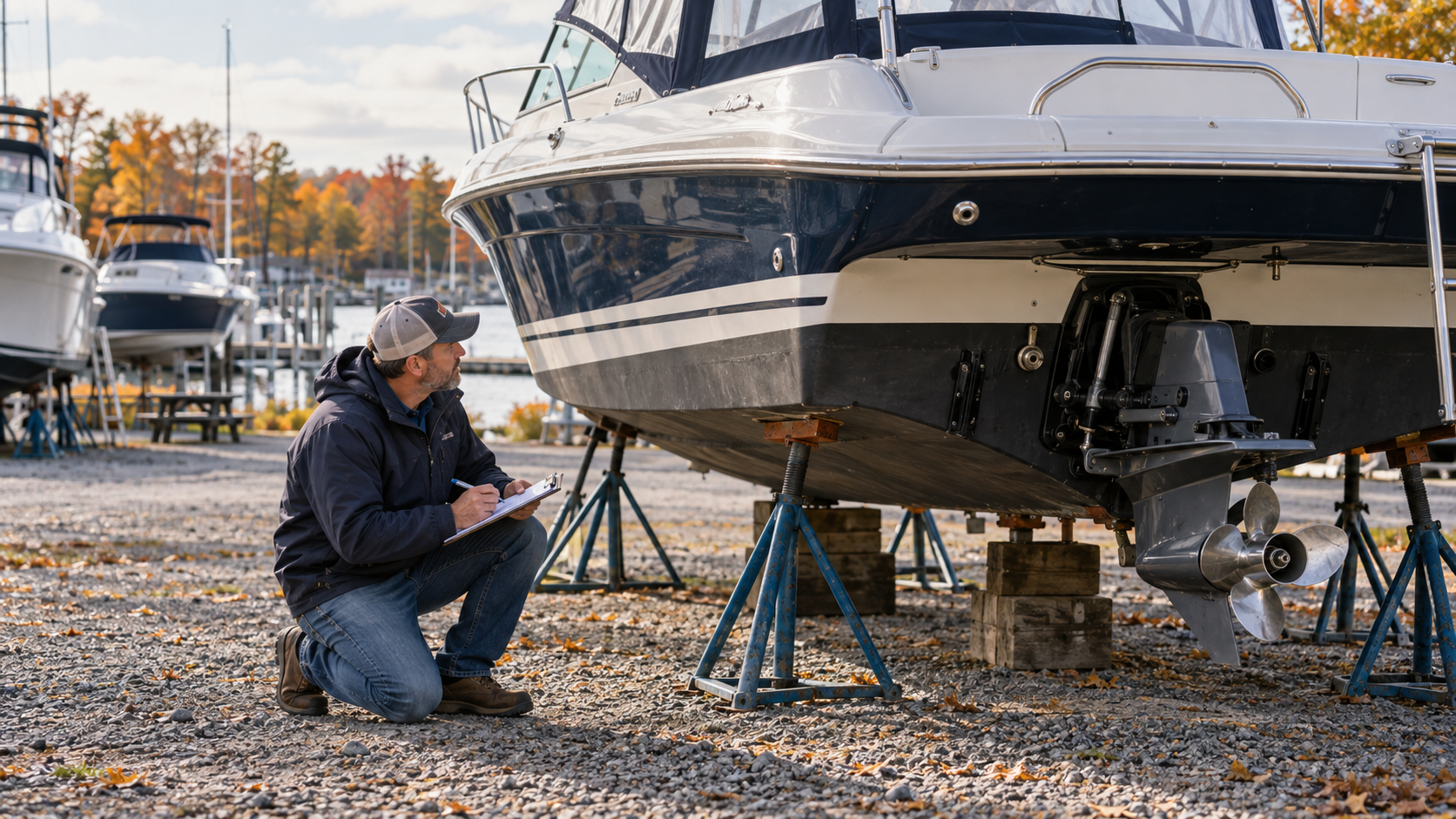
One last look before winter storage can save you time, money and frustration when spring comes back around.
By the time a boat is ready for winter storage, most owners are mentally finished with the season.
The gear is coming off. The marina is getting quieter. The days are shorter. Once the boat is winterized, covered and tucked away, it is tempting to simply move on until spring.
But before the cover goes on, take one more slow walk around the boat.
Not to perform another major maintenance project.
Just to look.
A final inspection while everything is still visible can reveal small problems that are easy to forget once the boat is wrapped, blocked or stored. It also gives you a chance to document what needs attention before another season begins.
Start With the Hull
Walk around the entire exterior before the boat is covered.
Look for scratches, chips, stress cracks, damaged rub rail, loose fittings or anything else that changed during the season.
Pay particular attention to areas near the bow, transom, swim platform and dock-side surfaces. Those are often where small bumps and scrapes show up first.
If the boat is already out of the water, look underneath as well.
Check the running surface, chines, trim tabs, transducers and through-hull fittings for anything unusual.
You do not necessarily have to repair every cosmetic issue immediately.
The important part is knowing it is there.
Look Closely at the Propeller and Lower Unit
If the boat is powered by an outboard or sterndrive, take a few minutes to inspect the propeller.
Small dings or bent edges can be easy to overlook during the season, especially if the boat continued to run normally.
Look for fishing line around the prop shaft as well.
Also inspect the skeg and lower unit for fresh damage, missing paint or signs that something was struck during the season.
A quick photograph now can be useful when you begin planning spring service.
Check Every Hatch and Compartment
Open everything one more time.
Storage lockers, anchor compartments, fish boxes, seat bases, consoles and cabin spaces can all hide moisture.
Look for standing water, mildew, damp gear or anything that should be removed before the boat sits for several months.
This is also a good time to make sure nothing valuable or unnecessary is being left aboard.
Food, beverages, sunscreen, towels, fishing tackle and batteries for portable electronics are all better off coming home.
Give the Upholstery and Canvas a Real Look
During the season, upholstery gets used constantly but rarely inspected closely.
Look at seams, snaps, zippers and stitching.
Small tears or loose seams can often be repaired relatively easily during the offseason.
Wait until spring, and you may discover that the problem has grown—or that every canvas and upholstery shop is suddenly busy.
If you have an enclosure, mooring cover or cockpit canvas, inspect that too.
Check for worn areas, damaged fasteners and seams beginning to separate.
Look at the Hardware You Normally Ignore
Walk around the deck and physically check the things you use all season.
Cleats.
Railings.
Grab handles.
Rod holders.
Seat bases.
Windshield hardware.
Hinges.
Latches.
A fitting that moves when it should not, or a screw that continually works loose, deserves a place on the winter list.
These are exactly the kinds of repairs that get forgotten once the boat disappears under a cover.
Take a Fresh Look at the Electronics
Power up the electronics one more time if the boat is still operational.
Make sure displays, gauges, navigation lights and accessories behave as expected.
If something has been intermittent all season, write it down now.
Also look at the installation itself.
Loose mounts, damaged covers, worn cables and corroded connections may be easier to spot when you are specifically looking for them.
Remove What Does Not Need to Spend the Winter Aboard
Winter storage is easier on the boat when unnecessary gear is removed.
Take home anything that can absorb moisture or deteriorate over several months.
That may include:
- Life jackets and cushions
- Towels and clothing
- Portable electronics
- Fishing gear
- Paper charts and manuals
- Cleaning products
- Food and drinks
- Removable batteries
- Anything valuable
Removing gear also makes spring commissioning much easier because you begin with a clean boat instead of sorting through everything you left behind in October.
Check the Safety Equipment
Before packing safety gear away, look at it closely.
Check expiration dates where applicable.
Inspect life jackets for damage.
Make sure flashlights still work.
Look through the first-aid kit.
Check fire extinguishers and other emergency equipment.
Anything that needs replacement can go onto your winter shopping list rather than becoming a surprise the first weekend you want to launch.
Take Pictures Before the Cover Goes On
This may be the simplest and most useful step.
Take photographs of the boat from several angles.
Photograph any damage or problem areas.
Take pictures inside compartments where work may be needed.
Document electronics installations, battery locations, wiring or hardware you plan to address.
Those pictures can be surprisingly valuable several months later when you are trying to remember exactly what you saw in October.
They can also help when discussing a repair with a mechanic, marina or service shop.
Make One Final List
Before you leave the boat, create a short offseason list.
Do not rely on memory.
Break it into simple categories:
Must be done before launch
Should be done this winter
Would be nice to improve
The list does not have to be long.
The goal is simply to capture what you noticed while the boat was still uncovered and everything was fresh in your mind.
Spring Starts Before Winter
The last walk around the boat may feel like the end of the season.
In reality, it is the beginning of the next one.
The small problem you notice now is the repair you will not be scrambling to schedule in April.
The photograph you take today is the detail you will not have to remember six months from now.
And the five minutes you spend making a list may save hours when launch season returns.
Before the cover goes on, give the boat one more look.
Spring-you will be glad you did.